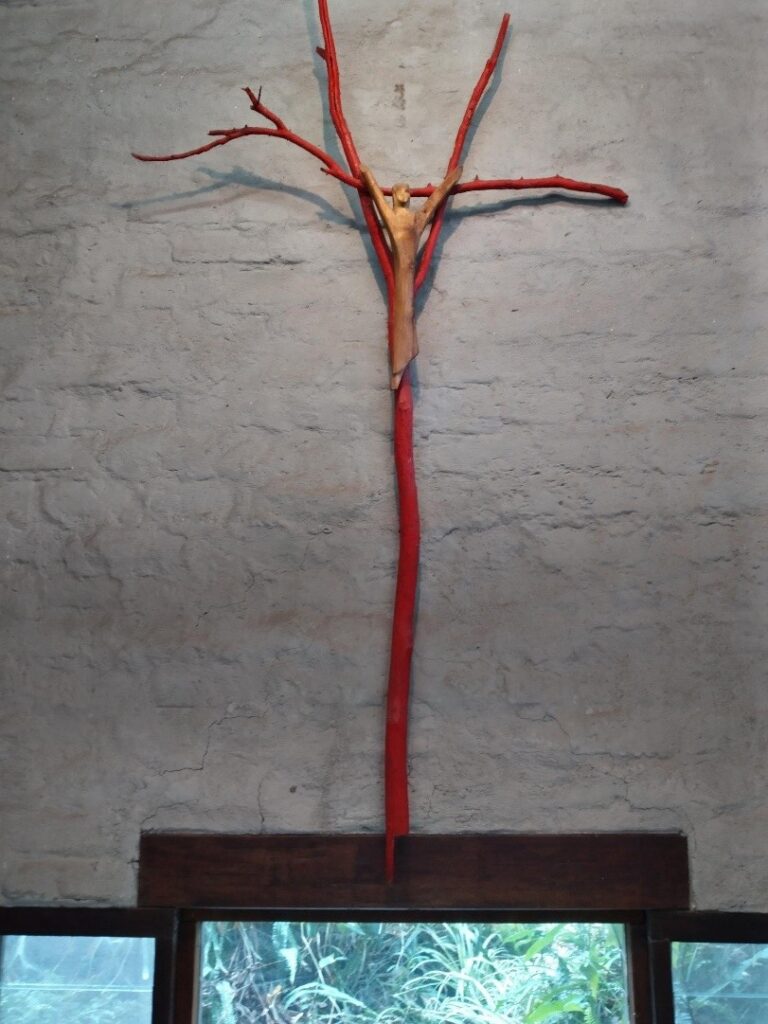
In the mudbrick chapel of Mary of the Angels in the Anglican Franciscan Old Monastery at Stroud, there is Crucifix which is, in its simplicity, profoundly revelatory about why Christ died on the Cross.
I have been sitting in the chapel and looking at it over several weeks. At first, the roughness and simplicity I found uninteresting, but as I looked more and more unfolded for me.
The branches that form the Cross were taken from the grounds of the monastery, and are part of incorporating the natural world into the divine space of the chapel. The chapel, as is the whole monastery, is made from individually hand-made mud bricks. The chapel rises from the earth like a sacred womb for the birthing forth of new insights and new life.
The word con-templation literally translates as ‘with the temple’. Contemplation immerses us into the intersection of the divine (the temple) with the human and natural world. Inside this chapel, one is both in a human world, but intersecting with the natural world as the silence is interspersed by the sound of frogs and birds, an occasional lowing of cattle, and the whisper of the divine.
The earthiness of the Cross is essential because Christianity is a story about the reality of life. It does not seek to pretend that we can live above and outside the suffering, but provides a means, through God Himself, to be able to work through the suffering in a way that actually still builds life and renewal.
The Cross is made from wood gathered from the monastery grounds. It is painted red, to show the blood and the physical reality of the torture and death of innocence at the hands of an unjust world. The carved wood body of Christ is left unpainted, revealing the natural grain of the wood, starkly contrasting the painted blood red of the branches.
Although the form of Christ is indicative of the natural world, and evocative of his humanity and oneness with his own creation, it is not a realistic form, but fluid in its contours. The shape seems to emerge out of the wood and be a part of it, as creation emerged out of the Word, and then the Word draws creation back into the heart of the Trinity.
In traditional crosses, Christ’s arms are stretched horizontally in agony. Here, they are raised to flow along the line of the wood and are reminiscent of the iconic portrayal of the risen Christ, his arms raised as he ascends into heaven. He is, here, both held by the Cross but also not confined by this means of torture.
This roughhewn but artfully-arranged Crucifix seems to show a Christ who is both one with nature, and therefore us, one who suffers and dies, like us, but one who is also and simultaneously, rising into the graceful new life of eternity.
Death has no final word; death has no more power. But suffering is still real and wrong.
This particular Crucifix shows the divine intersection into time: we look to see that Christ’s death is both real and final in that moment of time, but also that his death is the doorway, the portal to a resurrected life. Death does not, in this Crucifix, have the last world, for the Word is indeed active and cannot be overcome.
And gradually I came to see another sign of that divine intersection with the human world of pain. The Cross has two branches, but the vertical one has two branches, along which Christ’s arms are stretched – and supported. The horizontal branch intersects with the vertical at the spot which creates a triangle behind the head and heart of Jesus.
A triangle has three angles which is symbolic of the Trinity, and evokes the various icons, particularly 16 and 17th c. that show Christ, not alone in horror on the Cross, but lovingly and gently held on the Cross by the power of the Father and the Holy Spirit.
In his agony Christ may not see the Trinity, and cries out, “My God, my God, why have you forsaken me?” But the reality is, that God is present, as he is present in all suffering in the world.
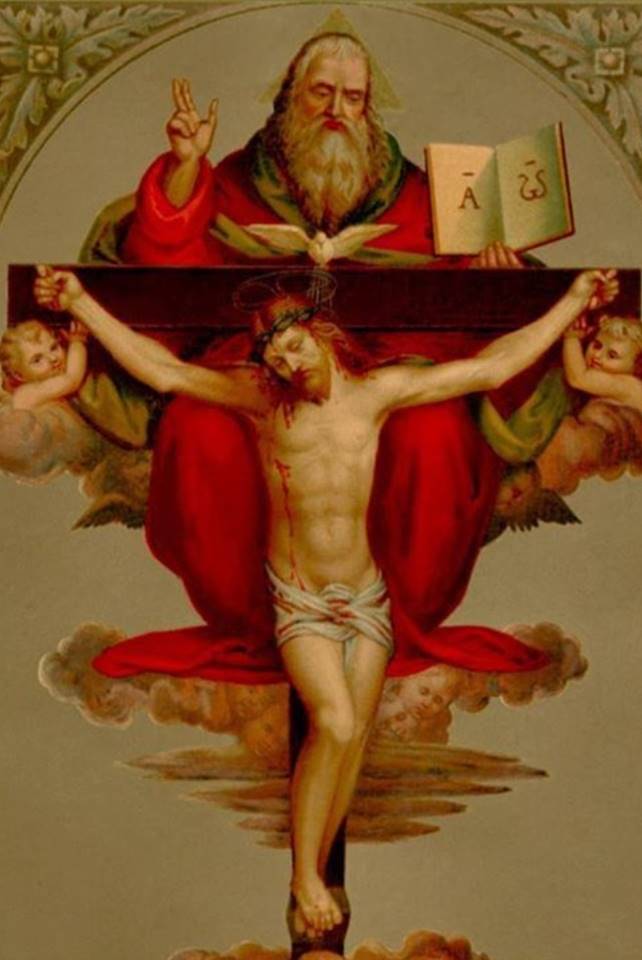
Christ, now fully stripped bare to the raw wood of creation, totally vulnerable, totally exposed is still also part of the Creator. The Body of Christ holds all the suffering people of God’s creation, God the Creator hovers over and with the Suffering of the world, drawing it through to the new life where there is no pain.
In that triangle, there is space, a gap. One could say a ‘nothing’ but that space is also the invitation to move past the bloodied wood, the broken flesh, into something else. It reminds me of the many icons which frame Christ. Normally these are ellipses, mandorlas, which evoke the infinity and timelessness of God, out of the nowhere from before time that Christ came.
The darkness draws our eyes and our hearts into something of the divine mystery, that place without images or words where the heart of the Trinity dwells, and from where emerges a never-ceasing flow of new life as God’s light washes away darkness to create something new and good and holy.
Christ died for our sins. Yes, I have known that, but I think I used to understand it as a one off something, for which I should be grateful, but I never really understood what it meant.
But here, in this Cross, I see that the Crucifixion is not a picture of a moment in time, but a window into God’s all-time relationship with all of creation.
God’s desire is that his beloved humanity should sit with him on his right hand, as co-creators with him of this glorious creation, stewarding resources for the flourishing of all, building communities which truly reflect the nature of the Trinity.
But sin comes in, the dark chaos that destroys and pulls down, and separates humans from God, from others, and from their true selves. And so there is suffering as humans hurt one another and their own selves.
But God shows us that he sees, he notices, and he is doing something even when we cannot see it. We cannot overcome the darkness and the lies that we tell ourselves to make ourselves feel better, and the cruelty of others; all this is too difficult for us alone.
And so the Trinity comes, in Christ, to experience all the pain and the grief we do. No longer to be separate but kind, but to be totally stripped, vulnerable, bloody and helpless so that we will know, deep in our spirits, that we are never as close to God as when we are stripped bare, vulnerable, bloody and helpless.
This Crucifixion calls to us in whatever is happening, from tragedy to the irritations of everyday life, that nothing we experience is irrelevant to God. He sees our pain and holds it.
And when we see someone suffering, then do we turn away, frightened at their pain, or turn to them, to hold out our arms (metaphorically or literally) knowing that God wills to hold us both in his compassion? Do we realise that “Christ died for our sins” draws us into the present activity of an eternal compassion moving through the world, through life, healing where he can here and now, and healing what cannot be made whole in this life, in the next.
Do we look away from suffering because it is not ‘good’, and it certainly isn’t good. But when we look away, we miss the opportunity to experience the presence of God in the here and now.
Contemplation draws us, not into ethereal realms beyond human pain, but into the reality of life but with a different approach. Bad things do happen to good people, the body cannot endure all things, but we are not passive victims of that darkness.
When I look at this Cross, I realise that my prayers for people who are suffering are often fear prayers: dear God, please don’t let this or that happen. A natural prayer, but one that comes from fear and not from the heart of love, and so does not have true power.
Looking at this Cross, I am encouraged to hold those I know who are suffering in the body of Christ, knowing that that Body is held by the Father, and the Holy Spirit. When I can do nothing, which is often, I know that I stand with Mary and John at the foot of the Cross, and they with me, and we wait. We wait feeling helpless, but also now, knowing deeper than that gut wrenching pain, that God is at work. And that in this crazy world when we do not know what to do or to say, there is a rock firm surety that as long as we stand with the utter goodness and grace of God, willing his compassion and will, we have done all that we can.
And indeed, willing God’s will is enough! Let the Creator of Life be!
Then the king will say to those at his right hand, ‘Come, you who are blessed by my Father, inherit the kingdom prepared for you from the foundation of the world,’