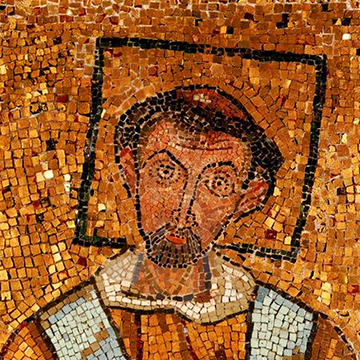
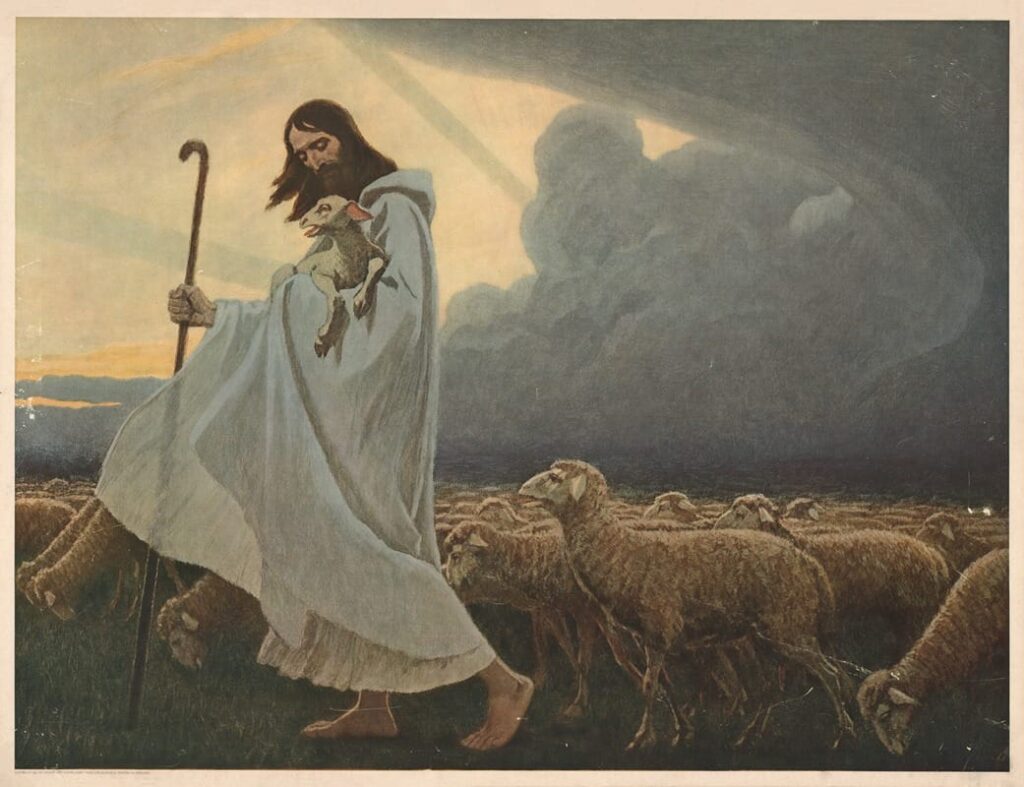
One of the most powerful images of God is the comforting, nurturing image of Christ as Good Shepherd, caring for his sheep. Psalm 23 is the most frequently read at funerals because it clearly epitomises what most people want to hear– the voice of God’s comforting presence in their grief, the reassurance of God’s continuing love for the departed. But the shepherd image is far more than a personal security blanket for us in our troubles—the Shepherd doesn’t just comfort in the present, he also calls us to be part of the renewed life for all.
Jesus comes to bring abundant life, which is far more than just having our sins erased, our faults and wrongdoings forgotten; he has come to bring us to new life that is flourishing. Often our view of salvation—like repentance – is far too narrow. David Lose writes: Salvation is often understood as the erasure of our sin and failure rather than the creation of new life and possibility. Forgiveness of sin is wonderful, of course, but it occurs to me that if that’s all we understand salvation to be we are, at best, only back to square one and miss that Jesus offers not just life, but life in its abundance…..we are not only saved from something but also for something, for life in all its abundance here and now.* http://www.workingpreacher.org/craft.aspx?post=3198
Our view of salvation is too narrow if it sees salvation as simply clearing away sin, and also if it sees salvation as simply signing up to Christianity. I am the gate to the sheepfold says Jesus. You need to come through me. Some have taken this to mean that only Christians (and particularly Christians of a specific denomination) will be saved. So, this interpretation breeds a triumphalist tribalism– we are in the right group and everyone else isn’t. But this form of competitiveness, of building barriers against other human beings, contradicts Scripture which talks about the Body of Christ– we are all one in that we are creatures of the one God who formed us in his image. We can deface that image– and we do so when we fail to see the other person as loved by God.
Peter talks of the new Christians as living stones, building together a spiritual house. This is the abundant life Jesus speaks of, not a world where I get what I want for my comfort, but a world were I am made alive in a new way by the loving relationships in which I am involved. It is a spiritual house, not a material one. Like the early Christians we live in a society of many faiths and competitiveness of humans in society breaks society, for there will always be losers in such a worldview. But we are called to hear, not the voices of populists, media, those who want to manipulate others for political or financial reasons—these are the bandits who break down society. But we are called to hear the call of life and love and to act in that way with those around us.
The Good Shepherd is trying to build a new society that looks different from the violent, competitive, pressured one we have in this world of resentment, fake news and AI slop. So he says: listen to my voice- not the voice of others: of the media, of culture, even of your own family or friendship circle. Because some of these human voices may not be saying the same things as God does. We have been given a brain to reason with, to discern what is of God and what isn’t. When friends and family encourage us to think only of ourselves, we need to go to God and ask: is this selfishness or is it self care? If our social media page keeps feeding us fear, we have to ask if this fear which is encouraging us to turn against specific groups of people or individuals is really from God or not. Perfect love casts out all fear.
Yes, we have to be aware of where there is danger, and avoid or disarm it. But, as Christians we need to keep hearing the voice of the Shepherd: our role is to follow him and that means to live as he did; in the inner peace of forgiveness and compassion. When our hearts are full of anxiety and chaos, then we cannot hear the Shepherd. Negative emotions feed negative emotions and cause the destruction we are seeing int eh international sphere at the moment.
But this is not ‘life’, let alone life in its fullness. We are called to new life in whatever is happening, but we have to listen for which direction to go in- towards something with courage, away from something with inner strength, but in whatever we are going let us try to build the well-being of others, self and the world.
The new life of abundance starts with us changing our hearts to reflect Christ.
Instead of being obsessed about the impending apocalypse, what about we start calling tomorrow’s world ‘abundant life? Or at least start thinking about how we can participate in building a society of abundant life, a true spiritual house? What makes our society good now? What can we continue to do to foster this well-being?
And if I can imagine a new and abundant life in the wider society, can I ‘see’ a new abundant life for me free from the fears and hurts of my personal life?
What do green pastures mean for me in my relationships? How can I better hear that voice of life and love call me into a freer way of life. What spiritual house am I building for myself and those around me?