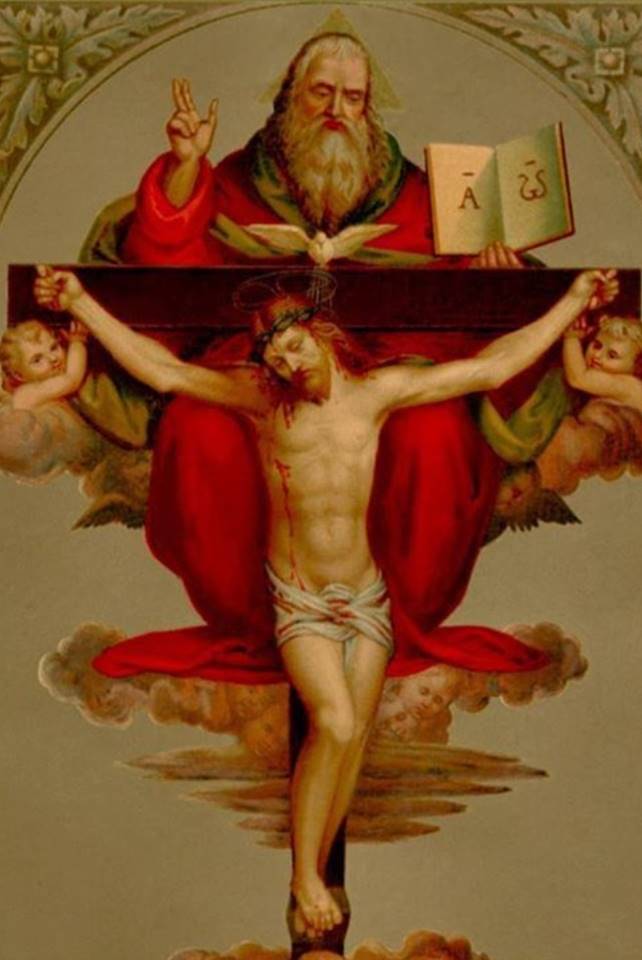
Is the power of the Trinity actually that it is a healing power? Preachers tend to veer away from talking about the Trinity, but in a hurting world it seems to me that we really do need to talk about God as true healer.
I think we can get sidetracked in trying to dissect analytically how three persons can be actually one. It is not something that makes ‘sense’ but it is simpler to understand if we talk about the persons, not only as individuals, but individuals in relationship.
And that relationship is one that is mutually beneficial for all three. In fact, they all flourish in this Spirit of love. There is total harmony between them, as each cares for the flourishing well-being of the other, and knows itself totally loved. Imagine what it feels like at the heart of the Trinity: utter peace, but also incredible dynamic energy.
We all want peace but most of us don’t seem to know how to get it. But the notion of the Trinity is actually a way to see how to get to that peace. It is through compassionate love of the other; it is about healthy relationship with God, others and self.
It is in fact, the Two Great Commandments: You shall love the Lord your God with all your heart and with all your soul and with all your mind.’ 38 This is the greatest and first commandment. 39 And a second is like it: ‘You shall love your neighbor as yourself.’ (Matthew 22.37-40).
Christianity sees God not as a distant spirit, unchanging, removed, perfect and separate from us. Rather, it understands that Father, Son and Holy Spirit share in a dynamic dance of love that is far beyond human experience of love– and so powerful that it creates life, and renews damaged life.
This love which is constantly flowing from the heart of the Trinity is the life pulse of the universe and the heartbeat of eternal life. It is what brings spring after winter, dawn after night, new grass after fire, comfort after grief and hope in the dark. We are invited to share in this dynamic love by participation in the Body of Christ.
Think about that last sentence! We are invited to participate in the very power of Life that is God himself. And this invitation is not because of anything that we do or earn, it is because Jesus (God Himself) Jesus took on humanity in the Incarnation, and he carries this humanity with him, over the river of death and into the eternal life. The Resurrection and Ascension of Jesus prove that humans are not eternally separate from God but are meant to be with him forever. In Jesus, we are already in the eternal Trinity.
It is not God who wants to be separate from us, but rather our false ideas about who we are – unworthy worms and unlovable or, at the other end of the spectrum, those who think themselves totally independent and without need of God.
There is no such thing as a ‘self-made human’. We are shaped by those who reared us, by schools provided by others, by a social structure that gives us roads and hospitals and arts and culture. We are made by all of this, although we are still all unique.
Abuse, war, suffering can shape us in very negative ways. Trauma and moral injury are far more extensive than was thought. But one of the protective measures against post-traumatic stress can be foundational loving relationships. Love shapes us to be resilient, love gives us the courage to be ourselves, love emboldens us to go out and do more than we could without that support and encouragement.
The Trinity made us to reflect God’s image of loving relationships to God, to one another and to ourselves. We cannot draw on the life-giving power of love unless we love someone! We cannot simply ‘love’ – we need to love someone or something. Healthy relationships are what produce a healthy human. None of us is an island, we are all interrelated.
One of the saddest things I heard when I was a prison chaplain was that so many people said they had never known love. I remember one man, a violent, angry many whom I visited when he was in solitary. He had been sent there for beating up other prisoners. He was raging up and down the cell, crushing to powder the plastic spoon and cup that had held his morning tepid coffee.
I knelt down by the steel door, so I could show my face through the small flap and said hello. He didn’t want to talk, just rage and shout. I said I was there to listen to him, and stayed listening. Eventually, the raging subsided, and eventually, he came and squatted down on the other side of the door so we could see one another.
I asked him about his life, and he said he was essentially an enforcer for some of the violent drug gangs in Sydney. He was fists and knife for hire to enforce discipline, to terrorise, to keep the power brokers in power. He told me the different ways you could break bones, and how breaking bones sounded when crushed, how easy it was to kill. At first he was trying to shock me, I think, but then he started to tell me about how this life affected him.
He didn’t want it, but he couldn’t get away. He had been on the streets since a young boy, this was the only life he knew and if he didn’t do what he was ordered to do he would be killed.
All he really wanted was to have a family, a home and a steady dull job. And he had never known love. I almost wept with the sorrow of it all. Then he said to me, ‘There is an inside me and an outside me. The inside me just wants a family and a home. The outside me is the enforcer for gangs. I hate the outside me but I cannot change things.”
His insightful awareness of his divided self struck me. He was separated from his real self and in misery. He was a man made in the image of God to reflect God, that is the inside person. Still there, even though his life was dramatically damaged. But the love of God for him was still there, his instinct for God and real life was there. But he hated himself so much he couldn’t fully recognise how God was trying to release him from his false views of self as useless and evil.
And I have often thought about him and this divided self. How hard it is for him to break free from his toxic life. Australia’s weak justice system has little to offer people after release to support them to change and be free from bad relationships.
Humans on our own make such a mess of things. But God who creates us is always calling us back into relationship with him. And when we come into relationship with him we come into true relationship with ourselves.
We cannot let this inner self out without the help of God. God gives us His Spirit when we ask for it, to help us work in his will in our relationships. The gifts of the Spirit are courage, gentleness, compassion, peace, joy, self-control and perseverance (Galatians 5.22). Sometimes, we need divine courage to walk away from something toxic, sometime we need divine perseverance to keep going in a certain situation. Circumstances are different for different people, and so God provides different gifts.
But for all of us, whatever challenges we are facing, God is calling us to wholeness and that means to total spiritual healing. And healing means this coming together in love for God, each other and our own selves.
This healing comes from the Trintiy itself, it is not in our power, but we are required to work with God’s will. The paradox of the Christian life is that when we follow God’s will, not our own will, we actually come to the fullness of who we are meant to be. Our will calls us to fit in with others- even gang bosses, to follow cultural rules, not divine ones, it seeks to put our own comfort and ideas first and ignore or overlook other people’s dignity and rights.
The Trinity is self-sacrificing love and compassion and desire for the well-being of the other. This is the healing power. We cannot manage healing on our own, but when we do see that God wants us to be safe, protected and flourishing, then we can stand up against those things that are wrong. And we can find new life again. The Trinity is not abstract theology; it is the very life force of our souls.
This week: Can we take advantage of the glory of the Trinity, of God’s eternal desire that we become one in peace with him? What do I need to change about my responses to people who irritate, scare or worry me? How can I bring God’s will for flourishing harmony for me as well as for others into my relationships?