Pentecost How can we harness the power of the Spirit?
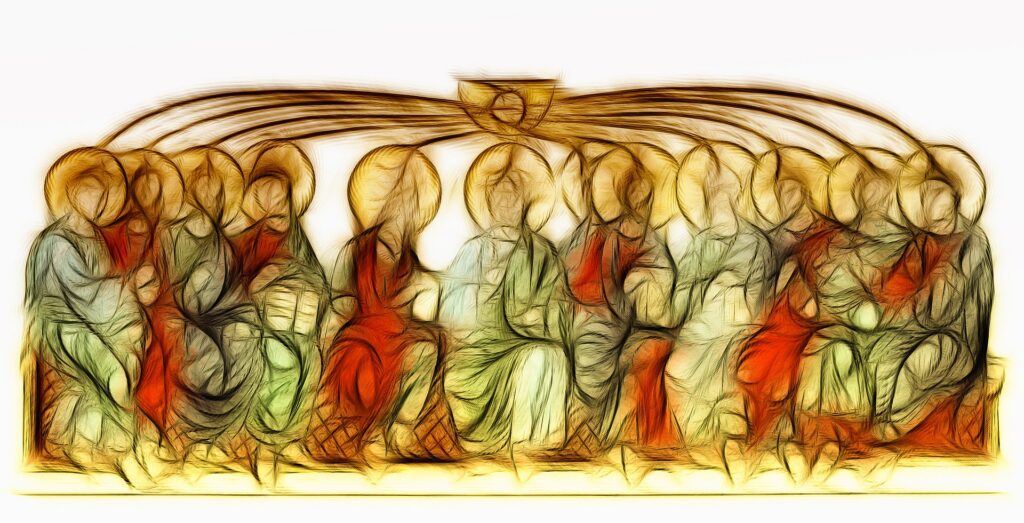
Wouldn’t it be wonderful if we could really harness the power of the Pentecost Spirit? God comes and the disciples are empowered to go out and people hear and understand them, and people are healed and miracles happen! Wow! That’s what we need in our aging and shrinking churches.
Pentecost raises a lot of challenges for Christians! Why aren’t we seeing the results that the early disciples saw? Are parishioners just not pulling their weight in evangelising? Do we actually believe that the Spirit is still active and working to renew the face of the earth?
The guilt in aging and shrinking congregations is enormous and, I believe, misplaced. The guilt is false if congregations feel they have failed to create a ‘successful’ church, with lots of people and good income, which will continue after they have died. There is nothing wrong with well-endowed flourishing churches, but I think, as Christians, we always have to seek what is the root desire for our actions, and are these desires really of God?
Is the desire to preserve what ‘we’ have? Is the desire to be successful as the world classes success? Humans tend to think there is safety and rightness in numbers, but the Spirit calls us to build an eternal Kingdom, not a worldly one. The early disciples weren’t actually seeking to build a ‘successful’ church, they were seeking to hear and to praise God. There were clustered in fear in the room to try and to make sense of the death and resurrection of Christ.
And Jesus came and breathed his peace and his Spirit into them. So, the beginning of good evangelisation is not individuals rushing off to convert others to build a bigger brand. Does this mean that we shouldn’t share our faith? Not at all, we are clearly called to do so, but I think it is worth considering a little more why and what we are sharing.
The gift of the Spirit is the love of God for his creation. This is what so dramatically altered the lives and the world view of the disciples. They were drawn, via the Spirit, into a new union with God to see and experience his love for them, and so to see his love for the world and all people. The joy of this revelation, that we are not lonely individuals cast adrift in this world of injustice and pain, is so great that they were impelled to share it with others.
This new insight provided the courage to overcome the fear of others, to endure martyrdom, to give of themselves for something greater than themselves.
And that ‘greater’ than themselves was not what we might today call the Church – our particular denomination, our particular building. We can work within our denomination to build the greater and wider Kingdom of God. In building the Kingdom of God, we may not necessarily see an increase in the size, wealth or ‘success’ of our particular parish or denomination.
Power is a subtle temptation, and desire for power separates us from God. Jesus comes to the disciples to unite them to himself and to the Father. And he shows them the way, through humble service to others, through self-sacrificing love.
The way forward for the Church is not, perhaps, more programs more human plans, but simply the encouraging and supporting of individuals and congregations to greater holiness of life. Because the growth of the Church cannot come through human means, but only through the changed hearts of people.
One of the odd paradoxes of our cultural insistence on individual responsibility for everything that happens to us, is that there is a culture of outsourcing morality and spirituality. Some parents think schools should teach morality, rather than themselves. And there is a tendency in Christianity to outsource spirituality: that is for ordained people, I will just mow the lawn and clean the pews! But the democratic nature of the Spirit wants to quicken every single human to grow in fullness of life- which is union with God himself.
The Kingdom is built on truth and love and so is built on spiritual values: indeed, on the gifts of the Spirit. We don’t have to strive for them, Jesus seeks to breathe these gifts into us, to make them part of our very life.
But we struggle, each of us, against this. We want our way, our comfort, our convenience our whatever. We are scared to reach out to others, we don’t want to step on toes, be too pushy etc etc. And God knows our weakness and our fears and he comes to us to give us himself, so we don’t have to struggle alone, so that we can be co-workers with him in his strength.
What is this Spirit Jesus gives so liberally? The Spirit is the love between the Father and the Son; the eternal, dynamic energy of the self-giving compassion for the well-being of the Other, the love that creates the galaxies and every living thing in order that they might share in this love.
Thus, the disciples were able, through the Spirit, to see something of what Jesus himself sees and knows about God. And filled with that infinite outpouring of compassion they are able to speak in languages that diversely linguistic people can understand (Acts 2). Other people feel heard by the disciples. Strangers in a strange town, the Medes, Parthians, Cretans come to Jerusalem for the festival, and are heard and understood.
The Spirit breaks down the fear that separates one from another, and the true self from the false self. The Spirit lets us experience the love of God for us and, secure in that love, we can do more than we thought humanly possible.
The Spirit lets us know that we are understood, loved, part of this creation that is constantly unfolding into something new and beautiful and good. And so we want to share this love with others. We cannot fully receive this love and not want it for others.
The Spirit is not just a means to feel good about ourselves, it calls us to the same self-sacrifice of Jesus.
Jesus says: “If you forgive the sins of any, they are forgiven them; if you retain the sins of any, they are retained.” (John 20.23). I think this is a challenge to each of us to check whether we are working for ourselves, or in the Spirit of God’s kingdom. Am I prepared to forgive others, to want the salvation of those who hurt me? Or do I hang on to resentment and victimhood?
This forgiveness is not saying that the evil done is ok- it isn’t good in God’s eyes. Jesus still bears the scars: God remembers every suffering and will redeem it. Christ’s forgiveness shows us the way through this world of injustice, cruelty and wrongness. Christ’s forgiveness is Christ’s acknowledgement that the people who maliciously, or out of fear, caused his death are flawed creatures, and he gives them over to his Father for justice and for mercy, that God may bring about his will which is actually that all are saved. Father, forgive them for they know not what they do.
The Spirit leads us to Truth, to a clear-eyed view of the darkness and evil of the world, and of the constant goodness and new life of God. It is not an either/or view of the world, but one that sees both, but knows that God holds both good and evil and is drawing the suffering through evil into the fullness of his new Kingdom where there is no pain or weeping. The Spirit shows us the possibility of God redeeming, or re-salving wounded souls. The Spirit gives us the courage to stand against the darkness, to work with the Spirit of utter goodness to affirm, against the darkness and evil, that goodness is the only way to build anything.
The Church grows when we (individually and corporately) choose to put God’s will first, to support each other to realise we are not working in our individual lives, but in the great Story of Scripture and of God’s Kingdom.
Is there a real awareness that we are bit players in God’s cosmic drama, or is there a tendency amongst Christians to carry on living our own lives and just allocating the church/God that little bit of Sunday time? Raniero Cantalamessa described this subjective, individualistic Christianity as the Ptolemeian theory of Christianity. The old Ptolemeian understanding of the galaxy was that the sun revolved around the earth, and the earth was the still centre. Do we see ourselves, individually, as the centre and see God as the satellite of our lives, to fix and smooth our lives?
Mark Clavier writes: “Christianity is irreducibly corporate and personal; it’s never individualistic. We are who we are not in isolation but in relationship: with God, with one another, and with the story we inhabit together.”
Is all that we do and say and want, what God wants? Because that is actually the essence of Christianity and Jesus, in his self-sacrificing love, shows us the way.
So that means, as St Therese of Liseux said, picking up a pin for the love of God, thanking him throughout the day, bearing with one another and with situations we don’t like so that God can build something beautiful elsewhere, forgiving those who irritate us so that something of God’s goodness can be made. The big changes cannot come unless individual hearts are in God’s heart.
There is a beautiful ancient hymn which really summarises what Pentecost evangelisation means:
Come Holy Ghost, who ever one
Art with the Father and the Son,
Come Holy Ghost our souls possess
With thy full flood of holiness.
In will and deed, by heart and tongue,
With all our powers, thy praise be sungl
And love light up out mortal frame
Till others catch the living flame.
The feast of Pentecost celebrates the founding of the real Church, the community of believers. It requires us to work together, but also to take individual responsibility for the continuation of God’s holiness in the world (which should be the definition of the Church!)
We cannot harness the Spirit to build what we want to see, but we can let the Spirit harness us for God’s work of holiness in the world. We can remain open to the Spirit, to keep asking for the gifts of the Spirit (compassion, gentleness, peace, forgiveness, courage, self-control etc. Gal 5.22) to equip every relationship we have.
Then, we might be delightedly surprised to find that we are a part of the new creation, of the loving Spirit of God renewing the face of the earth, and our tired hearts may flame with his love and ignite others!