Christ’s miraculous feeding occurs in all four Gospels, so it was clearly highly important to the early writers. And, I believe, it is highly relevant to our world of spiritual hunger and uncertainty.
First, the background. Matthew’s version has verbal echoes with the escape of the Israelites from the Egyptian slavery. The Gospel extract begins: “when Jesus heard this.” The “this” refers to the death of John the Baptist, his cousin, who was murdered to appease the tyrant Herod. Truth telling is dangerous, the worldly systems of power do not like contradiction – whether Egyptian pharaohs or Roman governors, or modern presidents. So a parallel is being set between this miracle and the miracle of Exodus- the escape from Egypt.
Jesus goes into the desert to find space to pray, and the word for desert (eremos) is the same as that used to describe the Israelites entering the desert after their escape. The crowds follow Jesus, “on foot” (pedes) the same word used to describe the march of the Israelites.
In the desert God fed the Israelites with manna. Here Jesus feeds the people with bread and fish.
The Old Testament verbal echoes helps us to consider this New Testament story in the light of who God is: the one who frees us from slavery and provides for us. But the Matthew story shows us more. This version is not just about the miracle working God, who magics up things for our benefit. This version integrates humans very much into God’s provision as co- workers in God’s provision and blessings.
And the personality of God, as deeply compassionate to suffering, is also much stronger in Matthew than in the Exodus version.
Jesus was needing a bit of quiet time to process the horror of John’s death, but the crowds followed him. He could not get away. How did he respond? When he saw them he had compassion for them and cured their sick. This compassion, this gut-wrenching concern for the well-being of people, overrode his exhaustion and care, so that he worked all day in healing the people.
There is a correlation between compassion and healing: the healing comes from the God of compassion; the healing pours from this heart of concern for the suffering. And this heartfelt care for the other is starkly contrasted by the disciples’ initial response to the situation. They recognize that night is coming – a dangerous time in the wilderness and that the people need feeding. Thus, it is understandable that they tell Jesus to send the people away to buy food for themselves.
But there is something unfeeling about their approach. There is a problem, and yes, they only have a few loaves, but there is a certain callousness here, an attitude of let-them-sort-out-their-own-problem. What if they have no money, how far is it to walk, is there anywhere to actually buy food?
This callousness is still seen in politicians and people who believe that people’s hunger or illness is not their concern. Individualism insists that people should pay for what they want, or not get it.
However, the Old Testament is chock full of commands by God to feed the hungry and the poor. It wasn’t a new concept! The disciple’s ungenerosity also contrasts markedly with the fact that Jesus has been working all day healing people for nothing at all!
The passage challenges me to question how generous I am in my attitudes and giving of time, resources and money to others? How ready am I to help someone, or to send them away because I feel inadequate.
Sometimes it is not callousness that stops us giving, but fear and inadequacy. Jesus says to the disciples, They need not go away; you give them something to eat. We can imagine their sense of helplessness, perhaps even frustration because they know they only have a few loaves and some fish. It is not enough!
However, Jesus wants them to see beyond the purely human and their own possessions. Focus on self and limits excludes God from our world. But don’t we do the same with church finances? We see what we don’t have, and believe we cannot do anything.
We might pray for help, for someone else to turn up, for a miracle to happen, for things somehow to change. But Jesus is clear; he is not going to be seen as the miracle worker, who fixes things for passive people. He wants the disciples to participate in his blessing.
He says: you give them something to eat.
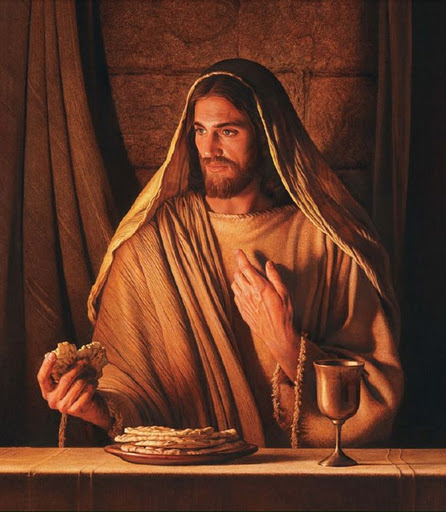
Certainly, it is Jesus who takes the piddling offering, blesses it and opens the cornucopia of abundance. But he gives the bread and fish to the disciples to hand out, and to gather up the left overs.
Think about that. As they went around with the food they would have looked into the faces of the hungry, they would have known the gratitude and relief of the parents of hungry children, they would have experienced the pleasure of being able to help someone else; and they would have been able to see blessings multiplied. And what does that do for their own understanding of who God is how he cares for others, and their own understanding of what ministry really is?
Because ministry is a sharing of God’s blessings with others. It does not come from our own source of goodness, and is not limited to our very small human source of goodness. But when we let a little of God’s almighty compassion flow through us to another, then we are in the channel of his mystery and of his power and his blessing. And it is good and easy.
But God’s ministry does involve our active participation. It is easier to simply pray that God will turn up with the goods. And sit down. But his mission is for our salvation and our salvation does need us to be trying to work in his Kingdom. We cannot outsource our spirituality.
What happened in the wilderness with Jesus was a miracle, but I prefer to call it a consecration. It was the consecration of what the disciples had. When something is offered to God, in love of God, and out of compassion for others, then God’s power is able to manifest itself.
And that is the difference. What is, as a church, we didn’t focus on our lack of resources but on how we could exercise compassion on someone?
There is a story about a congregation somewhere whose church had a disability ramp that was a drawcard for skateboarders to zoom up and down at all times of the day and night. The parish council wanted to put up a barrier to stop those annoying young people using the ramp. Send them away, as the disciples said.
But one person said, I think they are bored and hungry for life. Let me offer pizza and soft drink to them one night a week, and have an open session on any questions they might have. And the young people came, and gradually over time learned to trust the few parishioners who met them and listened to them, and started to care for them. And then there was a youth group. And then there was growth.
Growth of the Kingdom comes from love and compassion. And compassion operates out of one human heart into the life of another.
As we go towards communion, to receive the Body and Blood of Christ, are we opening our hearts to the compassion of God for all his creatures? Are we intending, consciously, to then share that compassion with whomever we meet this week?
In ourselves we do not have many resources. We may be poor, shy, uneducated, busy and these can become excuses to send people away. And they seem to be reasonable excuses to our human mind. But Jesus says, Bring them to me. Bring me your inadequacy, and let my compassion fill you and flow through you.
Let me liberate you from those things which diminish your life: your sense of being too poor, too shy, too uneducated, too busy. These are the Egyptian slave drivers of your life. Look not inwards to them, but outwards to the suffering of others in compassion, and you will find new freedom in the wilderness. For there is manna to feed you and my compassion is enough for you.
This week: can I pray to exercise compassion on someone this week?